Radiators — Measure Before You Order
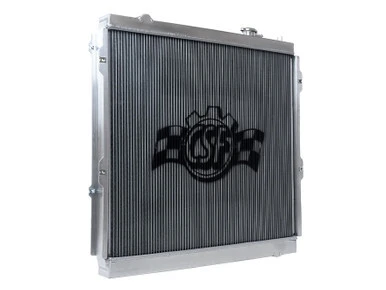
Two core sizes fit the 3RZ and 5VZ trucks, and they are not interchangeable:
Both are OE-spec replacements with a single-row aluminium core and plastic tanks.
Useful to know: both radiators include a built-in transmission fluid cooler. If you have a manual transmission you still use the same radiator — you simply plug the cooler fittings. There is no separate manual-transmission part to hunt for.
Water Pump — Do It With the Timing Chain
The water pump is a new OEM-quality Japanese-manufactured unit and the gasket is included.
Fit it whenever you do the timing chain. Both live behind the same front cover, and the labour is almost entirely shared. Replacing a water pump six months after a timing chain job means paying for that teardown twice, and a pump that was fine at the time of the chain job is rarely fine for the life of the new chain. A spare water pump gasket is available separately.
The 180-Degree Thermostat
The factory thermostat opens at 195°F, and the way it behaves matters more than the number: it cycles fully open and fully closed, which swings coolant temperature rather than holding it.
The 180-degree thermostat runs the engine cooler and, more usefully, holds the temperature more consistently. A cooler, steadier engine means a denser intake charge, less detonation margin used up, and longer component life — which is why it is a standard fit on built engines and a sensible one on a truck that tows or crawls in heat.
Buy the gasket with it. Thermostats do not include one, and the round rubber O-ring housing gasket is what stops it weeping afterwards.
Fans: Flex or Electric?
The 16" Flex-a-lite flex fan works on a simple principle — the blades flatten out as engine speed rises. Maximum airflow at low rpm where you need it, and minimum drag at highway speed where you do not. Less parasitic loss at cruise means slightly more power and slightly better economy.
That low-rpm airflow is exactly what a crawling or towing truck needs, when road speed is not moving air through the radiator for you.
A flex fan needs a spacer to sit at the right depth: buy the fan and 3" billet spacer kit together, or the spacer kit separately if you already have the fan.
Running the factory dual electric fans and one is damaged? The replacement fan blade is sold individually — far better than buying the whole assembly because of one chipped blade.
Silicone Hoses
The silicone radiator hose kit is dual-layered — high-grade silicone with heat-resistant embedded fibres — which gives better heat resistance and a higher pressure tolerance than rubber, and does not go soft and swell with age the way a thirty-year-old factory hose does.
Read the fitment carefully: this kit is for manual transmission trucks only.
Caps
The 1 3/4" radiator cap is a Sankei OEM-style Japanese part, 100% stainless, rated at 13 lb (0.9 kg/cm²).
Toyota used two cap sizes — a small 1 3/4" and a large 2 1/4". Measure yours rather than assuming; they are not interchangeable and the wrong one will not hold pressure.
If It Is Running Hot
Work through it in this order before buying a radiator:
- Cap. A cap that will not hold pressure lowers the boiling point of the whole system. Cheapest part here.
- Thermostat. A tired one sticks part-closed and gives exactly the symptoms people blame on a radiator.
- Water pump. Eroded impeller vanes move less coolant while looking fine from outside.
- Airflow. A clogged core or a fan that is not moving air at low speed.
- Then the radiator itself.
A truck that only overheats crawling or towing has an airflow problem. One that runs hot at highway speed has a flow or capacity problem. Tell us when it happens and we will help you find it.

 Silicone Radiator Hose Kit The New Silicone Radiator Hose Kits will provide your engine with a one-of-a-kind advantage in performance and style. These kits are dual layered, combining high-grade...$129.99