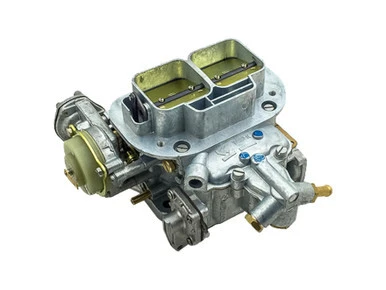
Weber 32/36 and 38 conversion kits, sidedraft carburetors, Offenhauser and sidedraft manifolds, adapters and gaskets for the 20R and 22R — assembled and jetted by LC Engineering.
Weber Sidedraft Air Correction Jet
Weber calibrated air correction jets are an essential component for fine-tuning your sidedraft carburetor, precisely metering airflow to the emulsion tube well...
Weber Main Jet
Weber calibrated main jets are an essential component for fine-tuning your carburetor, precisely metering fuel into the main metering system and emulsion tube assembly. Recognized...
Weber Main Jet
Weber calibrated main jets are an essential component for fine-tuning your carburetor, precisely metering fuel into the main metering system and emulsion tube assembly. Recognized...
Weber Primary Idle Jet | Fat Jet
Weber calibrated primary idle jets "fat jets" are an essential component for fine-tuning your downdraft carburetor, precisely metering fuel during idle and low-speed...
Weber Downdraft Air Correction Jet
Weber calibrated air correction jets are an essential component for fine-tuning your carburetor, precisely metering airflow to the emulsion tube well. Recognized...
Weber Carburetor Air Correction Jet
Weber calibrated air correction jets are an essential component for fine-tuning your carburetor, precisely metering airflow to the emulsion tube well. Recognized...
Mechanical Fuel Pump Gasket
Replacing your mechanical fuel pump? Ensure a leak-free seal and proper installation with an OEM Toyota Mechanical Fuel Pump Gasket. Built to exact factory specifications,...
Base Gasket (Pair)
Avoid or fix annoying vacuum leaks by replacing the base gaskets between your carburetor and intake manifold. We recommend this genuine Red Line Weber gasket to be replaced any...
Primary Idle Jet Holder
(w/ O-Ring)
This Weber jet holder holds the primary fat jet into the main housing on Weber 32/36 and 38 downdraft carburetors.
Contact our Tech Support Line for...
Secondary Idle Jet Holder
(w/ O-Ring)
This Weber jet holder holds the secondary skinny jet into the main housing on Weber 32/36 and 38 downdraft carburetors.
Contact our Tech Support Line...
Base Gasket (Pair)
Avoid or fix annoying vacuum leaks by replacing the base gaskets between your carburetor and intake manifold. We recommend these gaskets to be replaced any time the carb is...
Almost everyone arriving on this page is choosing between two Weber carburetors, and the honest difference is how they open, not how big they are.
The 32/36 is progressive — the primary barrel does the work and the secondary comes in when you ask for it. That is why it is the better carburetor for low-end power, drivability and fuel economy, and why it is the right answer for a stock or mildly built 22R and for anything that gets driven every day.
The 38 is synchronous — both barrels open together and feed the engine at once. That suits a modified motor that can actually use the airflow. On a stock engine it is not an upgrade over the 32/36; it is a different carburetor aimed at a different build.
Put plainly: if the engine is stock or mild, take the 32/36. If you have cam, head and exhaust work, take the 38.
Electric choke or manual choke?
Electric is set-and-forget and is what most people want. Manual gives you control on a cold-start-heavy truck and one less wire to fail. Neither affects performance.
These catch people out often enough that they belong above the fold, not in the small print.
1. Fuel pressure. These carburetors want 2.5 to 3 lbs. A stock mechanical pump on a healthy engine will usually oversupply that, so plan on the low pressure regulator and gauge kit as part of the job rather than as a fix after it runs badly.
2. Automatic kick-down cable. The Weber does not come with provisions for one. If your kick-down cable attaches to the bell crank, you are unaffected. If it attaches to the carburetor, it will need modification. Check which you have before the old carb comes off.
Carburetor Only, Kit, or Complete Package?
The same carburetor is sold three ways, and the difference is how much of the install comes in the box.
Conversion kit — carburetor, manifold adapter, filter adapter, linkage and installation kit. This is what most people should buy; it is the whole job in one box.
Carb and intake performance package — the carburetor with a performance intake manifold rather than an adapter on the stock one. This is the version that actually changes how the engine breathes: 32/36 electric, 32/36 manual, 38 electric, 38 manual.
Which air cleaner?
Several packages come with the air cleaner already chosen, which saves buying an adapter afterwards. A K&N filter flows well and washes out; the LCE Pro billet cleaner is the one people buy when the engine bay is going to be looked at.
If your state tests, you are not shut out. The smog-legal kits use a genuine Weber 32/36 DGAV and include the carb, manifold adapter, filter adapter, linkage and installation kit: 1981-1984 4WD Pickup and 1981-1983 2WD Pickup and Celica.
Sidedrafts
For a built engine where the goal is airflow rather than convenience, we carry Weber sidedrafts in 40mm, 45mm and 48mm, and complete kits in 40mm and 45mm. They run on the 22R sidedraft manifold with linkage, which takes the 40mm and 45mm carbs.
Sidedrafts are not a daily-driver upgrade. They reward a built motor and someone willing to tune.
Intake Manifolds
The Offenhauser downdraft manifold with the Weber flange has a large open plenum and runners that outflow the stock Toyota casting, and the single plane design gives mid-range and upper-rpm power without giving up low-end torque. Because it is cast with a Weber flange, the carburetor bolts straight on — no adapter.